“Values keep movements honest, while a material approach gets results, and there’s a time and place for both”, writes Mehran Khalili, though they go on to declare themselves inclined towards a material-first politics, and to support the Jeremy Corbyn -backed slate in the current Your Party CEC elections, as opposed to the Grassroots Left slate.
Ruth Wilson Gilmore has usefully defined racism as “the state-sanctioned and/or extralegal production and exploitation of group-differentiated vulnerabilities to premature death”: as anti-racists (thus equally anti-fascists and anti-imperialists) – that is, the only true Left – we organise against the big-asset owning class and its military/industrial/tech complex by all available means, trying to protect populations from exploitation, expropriation, or other harm related to their vulnerabilities to premature death. Is not such a struggle inherently one of values and of materiality?
The values-first or material-first distinction explored by Mehran Khalili comes from the material strength of the neoliberal authoritarian state’s violence and its associated hegemony of values, it comes from the tendency of people, however victimised, to turn their allegiance towards the strong – the death-deliverers – and not towards the fulfilment of potential, or the survival, or the development of people, populations or environments. In other words, it is part of our disablement. We need to try to write, speak, & act with pre-figurative conceptualisations, such as Gilmore’s, to attempt always to articulate the ways in which our values are related to the material welfare of the oppressed, related to building their capacity to survive and flourish.
Those of us who support a Your Party that is dedicated to ‘grassroots organising’ espouse those values because of intending, however difficult it may seem, to involve dominated, abused populations in collective organising, experiencing a group cohesion in resistance that might enable them to flourish, to flourish materially, even if there is a risk that, under currently developing authoritarian regimes, such organising might also result in them being defeated or obliterated. The other strand of Your Party that wants to get it ‘back on track’ wants to short-cut this work and achieve electoral positions within the hierarchy of violence to enable them to distribute material benefits to the oppressed class, ignoring the inevitable prevention of such largesse by the world-owning class in the absence of self-organised resistance by the organised abused populations themselves. Which side of this debate is really material-first? To my mind, it is also the side that Khalili characterises as values-first.
Capitalism and imperialism have always gone together, and both are systems for delivering death, or various configurations of the threat of death. Resistance requires courage and sacrifice that can only be attempted by organising collectively and by accepting all forms of resistance, big or small, hopeless or productive, as being an expression of the collective will, as the Palestinians have done and as the Kurds are doing in Kobane, and the people of Minneapolis are doing right now.
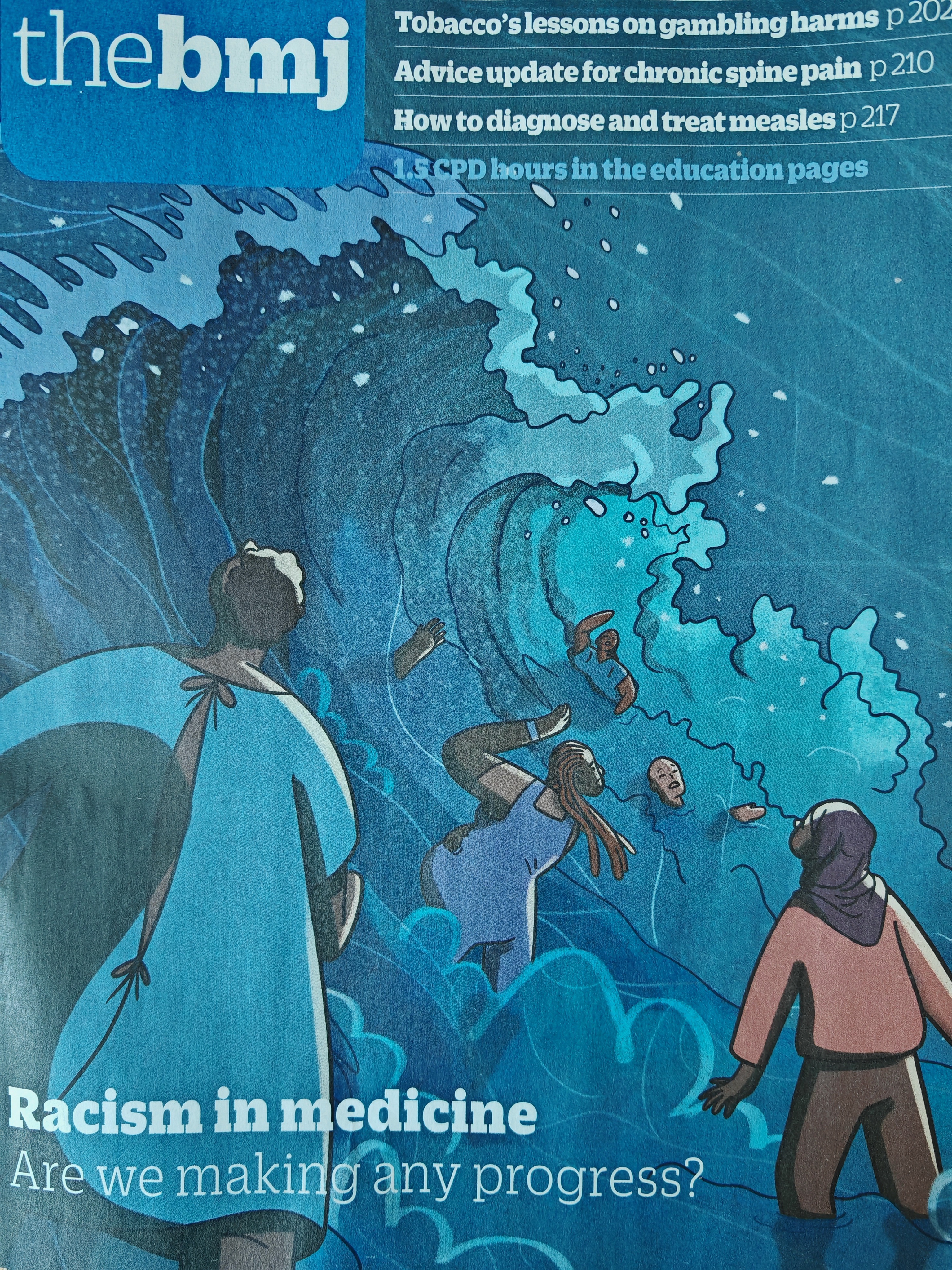
The British Medical Journal devoted its 22 February 2025 issue to a laudable topic, an attempt to document whether there had been any progress in the fight against racism in medical education and in the NHS as a whole since a landmark 2020 special edition which its editor-in-chief claims “brought fresh impetus to finding solutions to racial discrimination in medicine”. There are a number of interesting contributions to this discussion, including painful examples of recent episodes of abuse and discrimination in medical schools and hospital doctor interactions, and there seems to be a consensus that there has been glacially slow progress, if any.
The BMJ issue’s cover is a stylised depiction of black and brown bodies in various states of immersion, some with arms raised – not waving but drowning – beneath a huge threatening sea wave. This image evokes all that the text inside leaves out, surely taking many readers’ minds to the last decade’s regular news stories of desperate asylum-seekers drowning in the English Channel: and if not there, to the catastrophically large number of such deaths in the Mediterranean. It evokes lethal border regimes that are nevertheless not deemed worthy of any mention amongst the texts about racism in the NHS, even in a situation in which racist procedures are being regularly used in the NHS to deny treatment to impoverished asylum-seekers or others whom the border regime considers not entitled to it.
‘Fortress Europe’ and the UK’s border regime attempt to close down less dangerous routes to immigration for those desperate to escape persecution or impoverishment, which are always related in some way to the imperial metropoles’ imposition of debt, harsh terms of trade, or deteriorating climate. Such regimes simultaneously enact State racism through violence, and help to foster it, seeking means whereby the victims of domination will be blamed for their fate and seen as a threat, so as to shield the perpetrators. The means of State-instigated racism are proliferating all around us across the world, in the form of physical walls to separate populations, apartheid regimes where some sections of the people living in a territory, notably settler-colonists, are given the legal and property rights to enable them to dominate other sections, to the point well beyond daily humiliations, including carrying out ethnic cleansing, apartheid and genocide, the most dramatically obscene forms of State racism.
There has been much notable scholarship around the engendering of race. Particularly enlightening for me, Patrick Wolfe’s “Traces of History: Elementary Structures of Race,” London, Verso, 2016 and Sita Balani’s more recent text, “Deadly and Slick: Sexual Modernity and the Making of Race” London, Verso 2023 make clear that the building of Empire through its violent practices, but also through its production of modes of sexuality and gendering and its spreading of a class-based regime of ownership and means of accumulation of land and capital, is essentially intertwined with the production of race. The BMJ seems to want to discuss ‘race’ without any reference to social science, thus enacting a potentially essentialist and thus racist strategy in its own right.
Yet if anyone considers their own ‘race’ or that of any other person or group, they would not be able to do so without encountering threads of thought that take them to particular events that took place, or are taking place now, in history – for example, the Spanish conquest and pillage of South America, the Atlantic slave trade, the British Raj in India, settler-colonial projects around the world, the US-centred globe-spanning empire of transnational corporations, and in particular, at present, the systematic dehumanisation of lives that is being violently enacted in Palestine, in Yemen and in Sudan. It isn’t hard to see that race is created and sustained by the violent acts of dominating states, acting on behalf of privileged white-supremacist classes, whilst everyday racist abuses and discriminations are repetitions that simultaneously reinforce the subordination at which that violence aimed.
The stigmata that attract these abuses, whether of skin colour, language, or religious affiliation, widely worn with a defiant pride and claimed as their identity by those to whom they may appear to be inherent, are subject to dizzying changes according to the interests of the global property-owning elite – for example, their embrace of Zionism has entirely extinguished, deliberately, over only a few generations, the world’s multi-faceted populations of Arab Jews and Palestine’s ancient population of Palestinian Jews. Likewise, after 9/11, the identity category of British Asian has been cleaved by the new strategies of state-backed Islamophobia which have brought the religious affiliations of those of South Asian origin to the fore, along with the formula ‘Hindus good, Muslims suspect’, which not co-incidentally aligns with Hindutva’s embrace of fascistic racist nationalism. Moreover the stigmata are always modified – partially healed, as it were – by the distinctions of class, allowing the wealthy to ‘pass’ to different extents, whatever their skin colour, mother tongue, or religion. The triumph of Zionism in the post-World-War-2 founding of Israel, the culmination of an explicitly colonial project, was an enactment of Establishment antisemitism, finding Jewish refugees a homeland elsewhere, paralleling its pre-war reluctance to admit Eastern European Jewry as immigrants: simultaneously it constituted an alignment of aims which allowed that same Establishment to bury and renounce antisemitism as a State racist strategy and to use rather than abuse Jews in a different way as the lauded well-funded agents of their domination in West Asia, essential to the interests of the US-centred Empire, and the flow of oil.
If we seriously take account of these engines of race-creation, we can readily see that they are being accelerated all around us. We would start to see that attention to procedures of recruitment to jobs, ways of behaving as teachers of medicine or as providers of health care in the NHS, or indeed elsewhere, even if subject to modification so as to lessen racist abuse, will not in itself be sufficient; and indeed, that to focus only on these rather than attempting to modify, as it were, the health of societies, the health of the world, by stigmatising and reducing State-sanctioned violence is a political choice that will lead to failure. Does anyone really think that the NHS is shut off from a world in which the violent generation of State-sponsored racism is accelerating, whether in South or West Asia, in the USA, in Europe or elsewhere? Such violence may generate layers of workers for the NHS who can be paid a pittance and not be allowed to live with their families or to settle, but the presence of such workers under the circumstances of coercive recruitment is itself racism in practice, and will inevitably increase the incidence of everyday racism in NHS institutions. The employment structure of the NHS itself, which has all along relied on a supply of labour from abroad which it has not had to educate or train, and to which it can often pay less through various employment scams such as the out-sourcing of ancillary work, is inherently, structurally, racist – but the BMJ article on progress in combatting racism in the NHS apparently does not see this built-in racism, maybe it is too material, too real to cross their minds.
During the long years of construction of what is openly referred to in Israel as the Apartheid Wall, during previous episodes of mass slaughter in Lebanon and Gaza, as well as during the recent months of mass killing in Gaza, and in particular during the deliberate targeting of doctors for murder and abusive treatment and the deliberate systematic destruction of hospitals, the British Medical Association has remained largely silent, certainly avoiding the condemnation which an organisation which represented a group dedicated to providing health care and public health might be expected to make in the face of this massive triumph of murderous, torturing monstrous Anti-Health. This is driven by cowardice in the face of a well-financed bullying operation, perhaps, but also surely betrays an ultimate acceptance of imperialist domination as a structuring force across the world, which perhaps they think underpins doctors’ lifestyles in the UK and perhaps even the NHS itself. In short, this position, this contradiction, betrays the BMA’s own racism. With such leadership, progress against racism in our health care institutions will be glacial at best, and on current trends of accelerating State Racist practice across the globe, it will not happen at all unless and until massive collective resistance is mobilised.
 The People's Cries